



A shopper can now ask AI if your dealership is worth buying from and get a verdict that steers them away. See what being 'warned against' costs, and how to check yours.

Welcome to the REV. A weekly briefing on what the Auto industry can learn about customer experience from millions of Google reviews. Every Thursday, we Rank, Explore & Visualize automotive reputation & sentiment data.
Our latest research report dropped last week. It analyzes 1.2M Google Reviews from 18,000 U.S. dealerships across Q1, revealing what customers are saying across the auto industry. Check it out below:
Report: Q1 2026 Voice of the Customer Report
Read online. Subscribe to REV
A shopper doesn't have to read your reviews anymore. They can just ask. So we did, about a real Chrysler-Jeep store: is this a good place to buy a car? Word for word, the answer:
"Mixed reputation. Proceed with caution, insist on transparent out-the-door pricing in writing, and compare other options before buying."
That's a real result from a real dealership. Run the search again next week and the wording will shift; the read won't. We're not naming them; dragging one store isn't the point. But they never wrote that verdict, and they can't take it down. It isn't a review. It's the machine reading their reviews for a buyer and telling them to look elsewhere.
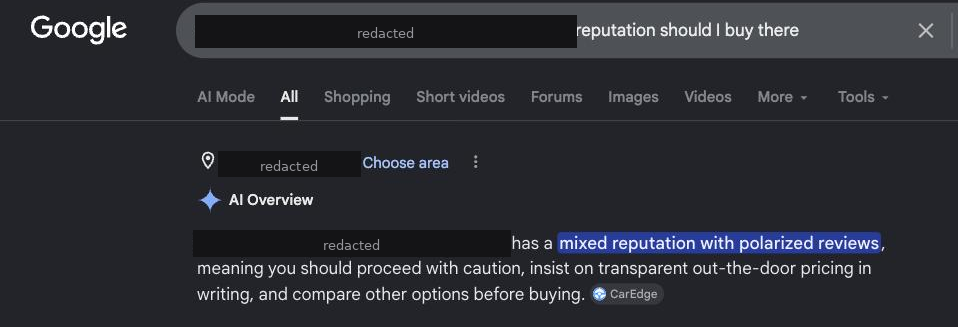
That's an AEO problem, not an SEO one. AEO — answer engine optimization — is what SEO becomes when a machine writes the answer instead of listing links. In search, the risk was going invisible. In an AI answer, there's a worse one: the engine names you, then steers the buyer away. That's being warned against. Invisibility costs a click. Being warned against costs the sale.
Search a store's name and you get the old world: a star rating and a wall of links. Ask a question, though — the way a buyer would, phrased into Google — and you don't get links. You get a verdict, built from the store's record across Google, DealerRater, Cars.com, Edmunds, even Reddit. And the broader shift is real: AI-referred shopping traffic more than doubled in the past year (Adobe Analytics). More buyers are asking, and deciding, before they ever reach your website.
Being warned against is rare. About 3% of dealers in the Widewail Index carry a lifetime rating under 4.0, roughly where the verdicts start to turn cautious. Most read fine.
So we ran the same search on a strong store: thousands of reviews, 4.8 stars. The verdict flipped. "Strong reputation, 4.4 to 4.9 stars. Yes, you should consider buying there." Then it added: "occasional issues with high-volume finance practices," citing a Reddit thread. Even a near-perfect rating doesn't buy a clean verdict.
That store could be any of the ones reading this.
So here's the free move. Ask Google or ChatGPT what it's like to buy from your store — as a question, not just the name. Search the name and you get stars; ask, and you get the verdict. Whatever comes back is the pitch every AI shopper now gets, written by something that never walked your lot. If it's not the store you know, the fix isn't the AI. It's the record it's reading, on every platform, not just Google.
The verdict is what your buyers see. Your Widewail Reputation Scorecard is the same picture from your side — where you stand, the benchmark, the gap.
On Widewail Live, Aug 13, Director of Marketing Jake Hughes and VP of Sales Matt Johnson read a real one out loud. No jargon, no pitch. 30 min. 12 pm ET.
Save your spot →
See you next week - Emily, Marketing @Widewail


U3GM Blog Post Comments