



Across 15,797 U.S. dealerships, two thirds own less than an even share of their county's Google reviews. The loudest stores are usually among the best rated.

Welcome to the REV. A weekly briefing on what the Auto industry can learn about customer experience from millions of Google reviews. Every Thursday, we Rank, Explore & Visualize automotive reputation & sentiment data.
Read online. Subscribe to REV
A reader wrote in after #080 with a question we had never run: what share of my market's reviews do I own?
This opened up a whole can of worms.
It's a really interesting competitive question. Of all the review activity in a given market, how much does each dealer contribute?
The answer is now possible because of the Widewail Index. We can look at every dealer and determine to what degree they contribute to the fabric of the automotive retail public commentary.
Start with the yardstick. An even share is one divided by the number of dealerships in the market. If twelve stores share a county, an even share is one twelfth of its reviews, about 8%.
Twelve is the typical county in the Widewail Index. Here is what its twelve stores look like, loudest to quietest, with the even share marked.
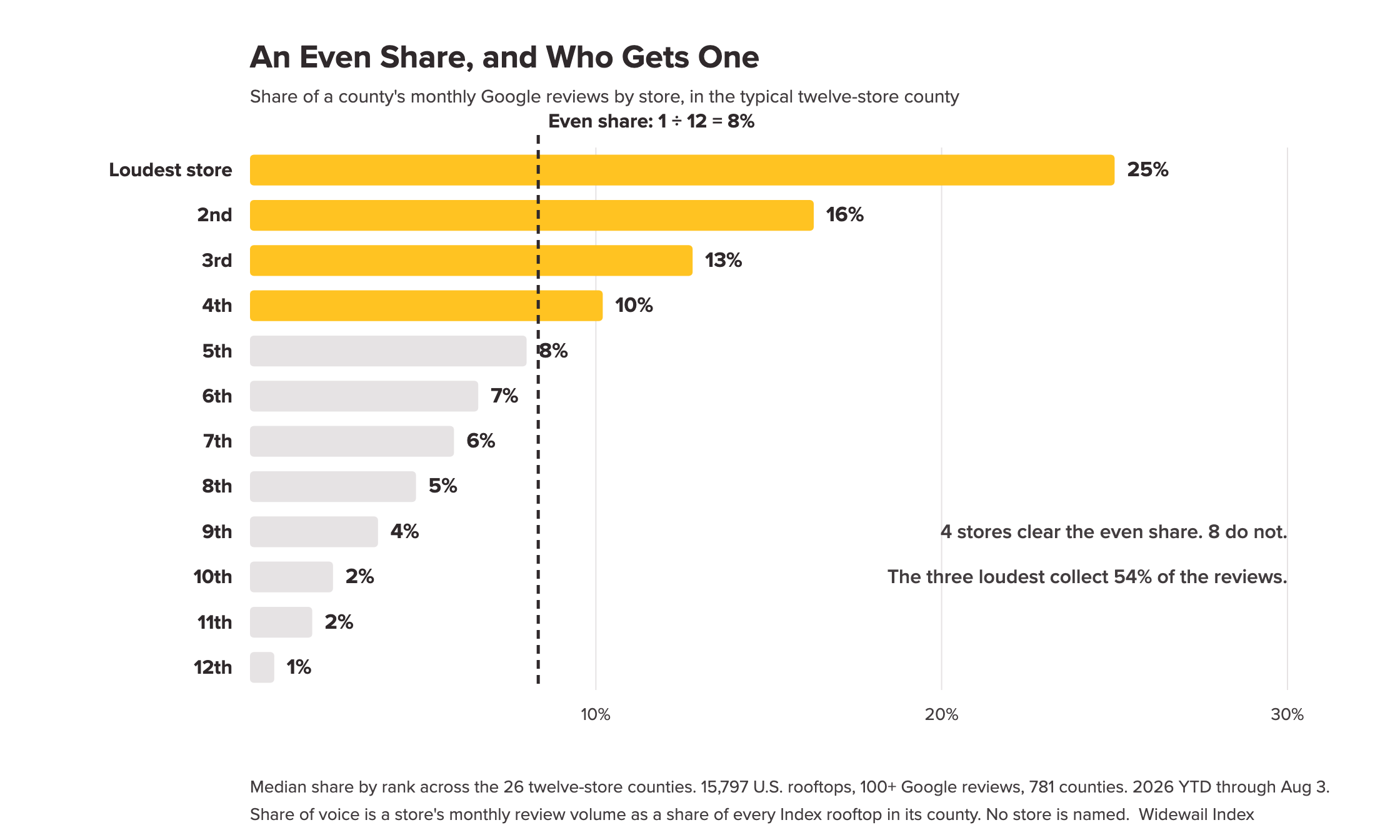
It's clear how much activity concentrates at the top.
Across 15,797 U.S. dealerships in 781 counties, 65% sit under an even share of their county's monthly Google reviews.
The data suggests most stores are fairly quiet in their own market.
Which got me thinking, does the picture change as markets get bigger?
Put the counties side by side by size and it gets more lopsided, not less.
In a county with five to seven dealerships, the three loudest collect 1.6 times what an even split would give them.
Twelve to twenty stores, 2.6 times.
Forty-one or more, 4.4 times.
The more dealerships a market holds, the further its top three pull away. In the biggest markets the three loudest stores take more than four times their even split.
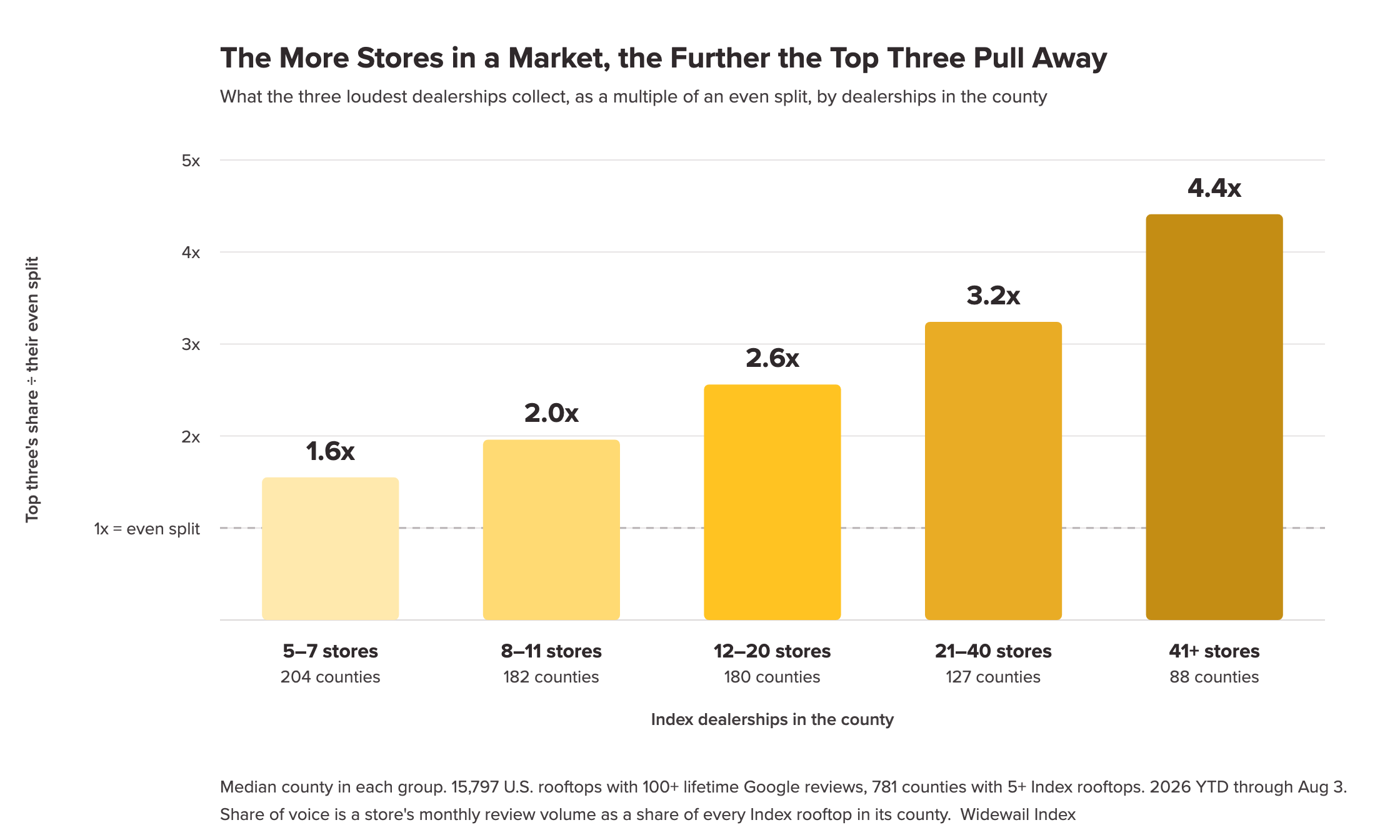
This surprised me, which is why I found it so interesting. It's the opposite of the obvious. As market competition grows, the big players further assert their dominance.
What it means for a store is that the yardstick moves. An even share in a six-store town is 17%. In a fifty-store metro it is 2%, and the leaders there hold many times that.
The big metros are where this is most pronounced, and where the most stores sit under the line.
| Market | Index dealerships | Under an even share | Top three collect |
|---|---|---|---|
| Los Angeles County, CA | 334 | 70% | 10.6x an even split |
| San Diego County, CA | 139 | 66% | 7.8x |
| Maricopa County, AZ (Phoenix) | 202 | 64% | 7.7x |
| Wake County, NC (Raleigh) | 84 | 70% | 7.1x |
| Nassau County, NY (Long Island) | 90 | 72% | 6.4x |
| Miami-Dade County, FL | 106 | 63% | 6.3x |
| Anne Arundel County, MD (Annapolis) | 53 | 76% | 6.2x |
| Harris County, TX (Houston) | 197 | 66% | 6.1x |
| Pinellas County, FL (St. Petersburg) | 45 | 76% | 6.1x |
| Hennepin County, MN (Minneapolis) | 81 | 72% | 6.0x |
So the stores that clear the line are the loud ones. Are they also the good ones?
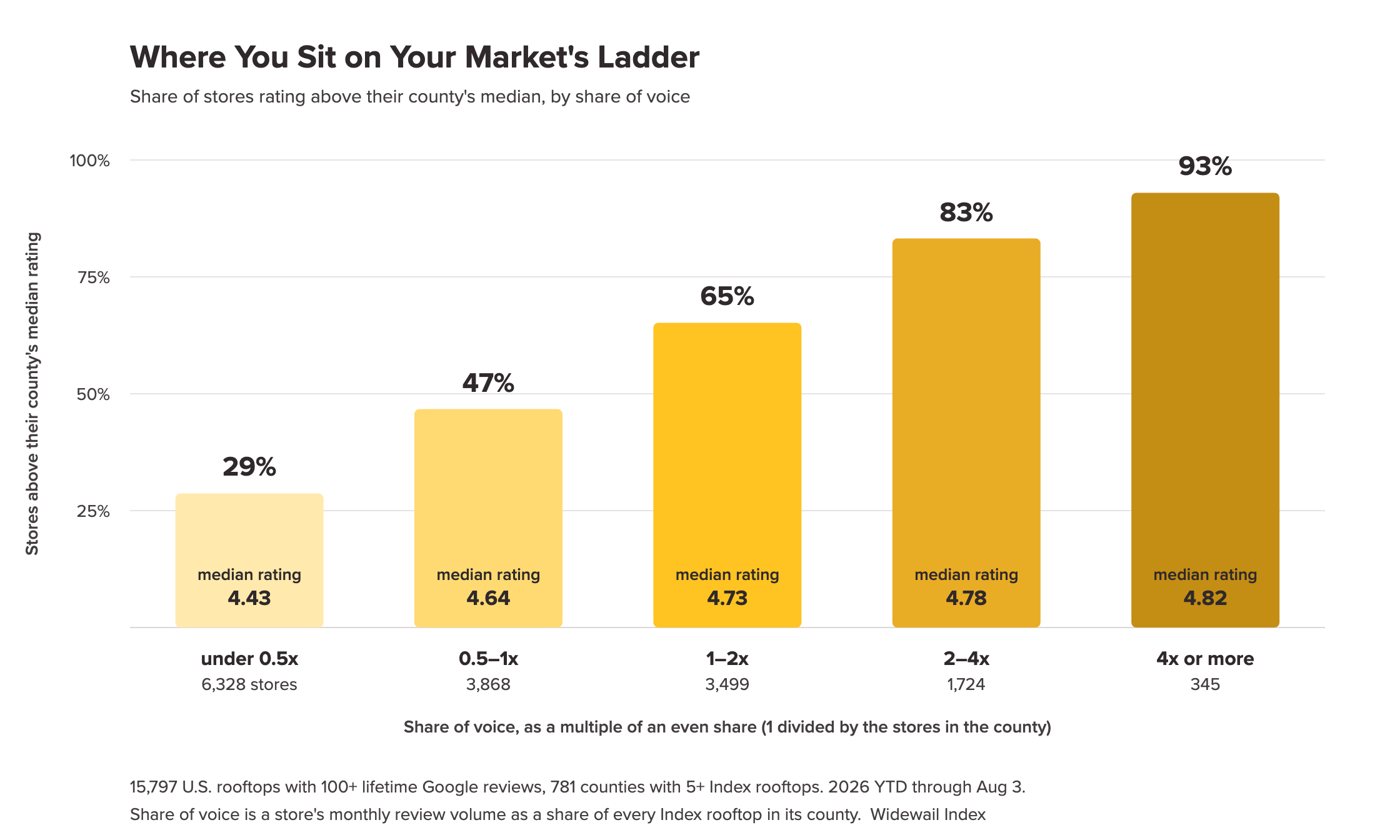
Share of stores rating above their county's median, by share of voice. It climbs from 29% at the quiet end to 93% at the loud end, and it holds inside every store-size group. This may measure who asks rather than who is better: soliciting reviews raises the count and the average together. The lever is the same either way. Count the dealerships in your drive radius, add their monthly review counts, divide yours by the total. Then ask, and answer.
2026 year-to-date through August 3: 15,797 U.S. rooftops with 100 or more lifetime Google reviews, in the 781 counties holding five or more Index rooftops. Share of voice is a store's monthly review volume as a share of all Index rooftops in its county. County is a proxy for a market, not a drive radius, and this is share of review volume, not market share. Review data from the Widewail Index.
New episode of What's Working in Auto is up. Listen here.
See you next week - Jake

U3GM Blog Post Comments