



Customer Clarity by Widewail reads every review you collect and hands you two things you can act on this month: who to coach, and what your market just did.
DMS integration is CDK-only at launch.
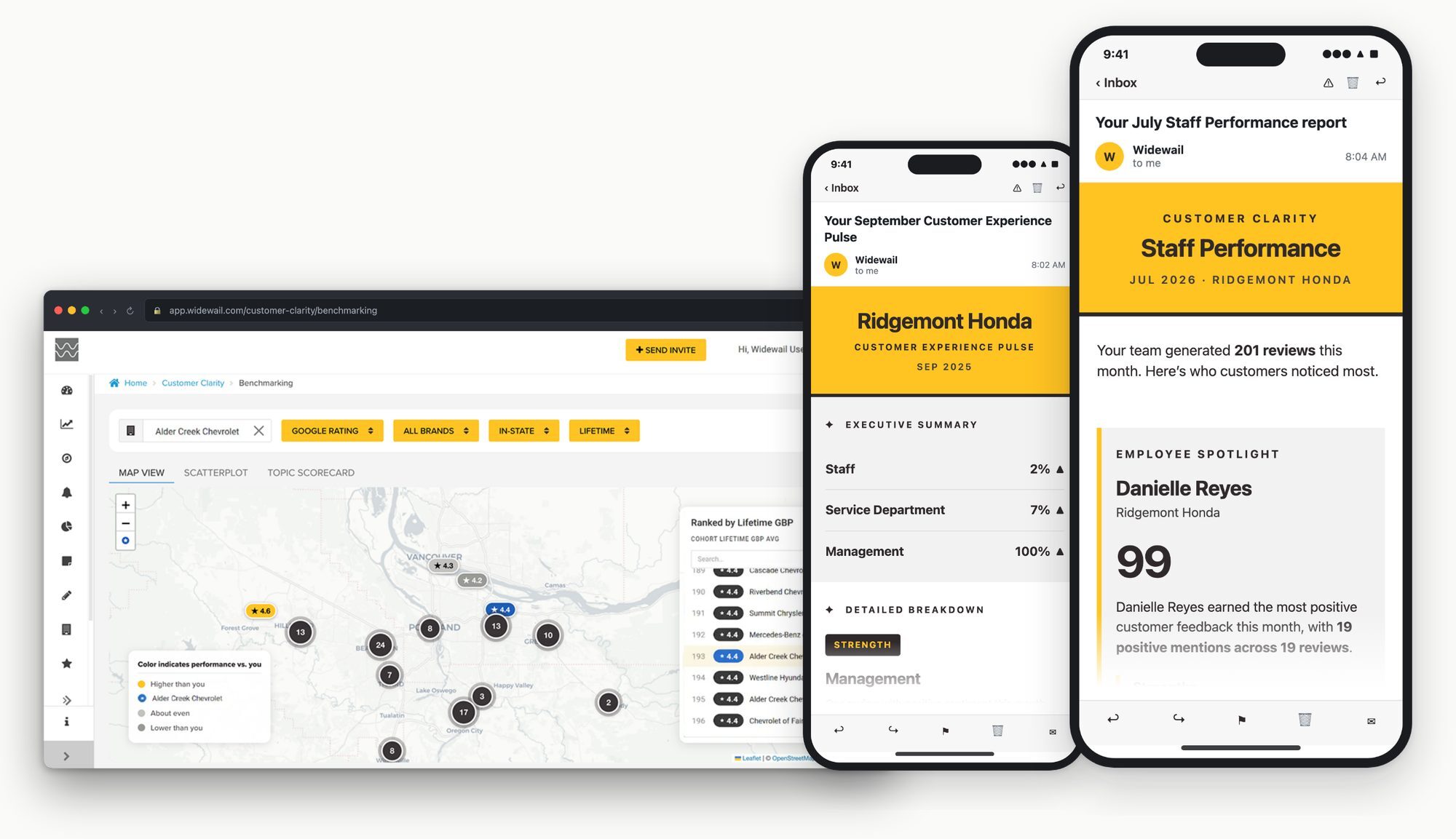
One page per person, every month: who customers named, what to celebrate, and the one thing worth a conversation.
One page per person, drawn from what customers actually said.
Marcus and Karen are the clearest leaders on service consistency; use them as peer coaches. Noel’s mix of praise with recurring comments on wait times warrants a focused coaching conversation.
Before customers leave, have Noel briefly name one concrete way he helped and confirm the wait met expectations.
Every person customers named, scored on what those customers actually said.
The praise that usually dies in a manager's inbox, pulled out and attributed.
The recurring themes worth one conversation, with the words to have it.
Snapshots arrive inside the monthly Staff Performance report. Nobody has to log in to read one.
The ranked next move for the person on the page, instead of a wall of charts.
Customer Clarity joins the review to the transaction behind it, and the join is where the insight is.
Every review scored on what customers talked about: wait times, communication, price, and more, plus the person they named, across every rooftop.
The visit behind the review: which department, which advisor, what the work was, and what it was worth. CDK at launch.
Sentiment attached to real transactions, so a pattern in the reviews can be traced to a person, a process, and a dollar figure instead of a hunch.
One trains your team with the customer's own words; the other watches what the stores competing with you did last month.
Every review that names one of your people, tied back to that person. Who to recognize this month, who needs a conversation, and the customer's own words to have it with. You already know who your weak performer is. This is the proof they will accept.
How staff performance works →Not a standing. A shift. Which stores actually competing for your customers gained ground since last month, on what, and whether it is worth 20 minutes of your morning. Your comp set is in it whether they buy anything from us or not.
How benchmarking works →The members of your team, scored on what your customers actually said, delivered each month in the Staff Performance email with your top three and bottom three.
"I feel like this is what you're doing with customers" is an argument. Twelve reviews naming that one person is not. Pull their mentions, read them together, and there is nothing left to debate. Younger staff do not take because I said so. They want to see it.
Every score clicks through to the reviews behind it.
A customer names someone for going out of their way, and it dies in a manager's inbox. GMs forward these by hand today and miss most of them. Customer Clarity catches every named mention and gets it to the person who earned it.
This is the job that applies to a good team, not just a struggling one.
Nobody counts that window, and it is where the money goes. A weak performer works for months before anyone connects the dots. Shrinking that gap from six months to one month is the return, and you can size it against your own numbers.
$12,398 is what one customer is worth across a single ownership period. Cox Automotive, 2026 Fixed Ops & Ownership Study.
Each person gets a specific coaching prompt, so you walk into the one-on-one knowing what to open with. The pattern comes from many reviews, not the last one, which is what stops it turning into an argument about a single bad day.
From the Customer Clarity one-sheet: pinpoint coaching opportunities.
Coaching shows up as a trend or it did not land. The same measure next month tells you which conversations changed something and which need a different approach.
This is the part that turns a report into a management loop.
Staff leave when nobody talks to them and nobody trains them. This generation wants feedback and will not ask for it, so somebody has to push it. A manager who can point at specific customer praise every month is a manager people stay with.
Across 350+ dealers, noticeably higher turnover tracked with about 6.5% lower monthly revenue.

“I'm able to pull individual sales people and go, here's what your score is. This is what people are saying about you. And it's instantly helping. And our scores actually are starting to climb back up, which is great.”
Customer Clarity matches reviews to your team whether or not the customer used a name, so every coaching moment reaches the person who earned it.
Seven times the matched reviews is seven times the coaching moments, every month, without anyone reading a single review by hand.
Customer Clarity shows what shifted in your market since last month, and which shift is worth acting on.
Two stores in your cohort gained ground this quarter and you did not. Both gained on communication.
Period over period was the single biggest ask out of beta. Who climbed, who slid, and by how much against where they sat 30 days ago. A store that went from 66 reviews to 200 is something you would never hold in your head. A ranked list you already carry there is not.
Review volume is tracked as its own competitive measure, alongside score.
A competitor climbing is. Alerts are weighted to risers, because that is the movement that changes what you do this month. Your own rank and everyone else's bad month stay out of the way.
Biggest movers, not a full standings table.
A riser in sales is a market you defend, and the answer is usually marketing. A riser in service is a process to go read: open their reviews, find what changed, decide whether to copy it. Different alert, different move.
Service is where most GMs say this earns its keep.
Point the same view at a market you are thinking about entering. The cohort, the rankings, and the topic detail all come from public review data, so you can read a market you have no stores in yet, and know your reputation there before your first dollar does.
Same Index data, different question: entry instead of defense.
This is the first objection every GM raises. A store with a thousand reviews measured against a ninety-review used lot is noise. So the cohort defaults to your metro and to stores near your size, and you can see exactly who is in it. Nobody loses a deal to a dealer three hours away.
Built on public review data, so your comp set is covered whether they buy from us or not. Three reference sets: nearby same-brand, similar-size, and the U.S. industry, on the four categories customers judge: staff, wait times, price, communication.
The insight only matters if it reaches somebody on a rhythm and tells them what to do next.
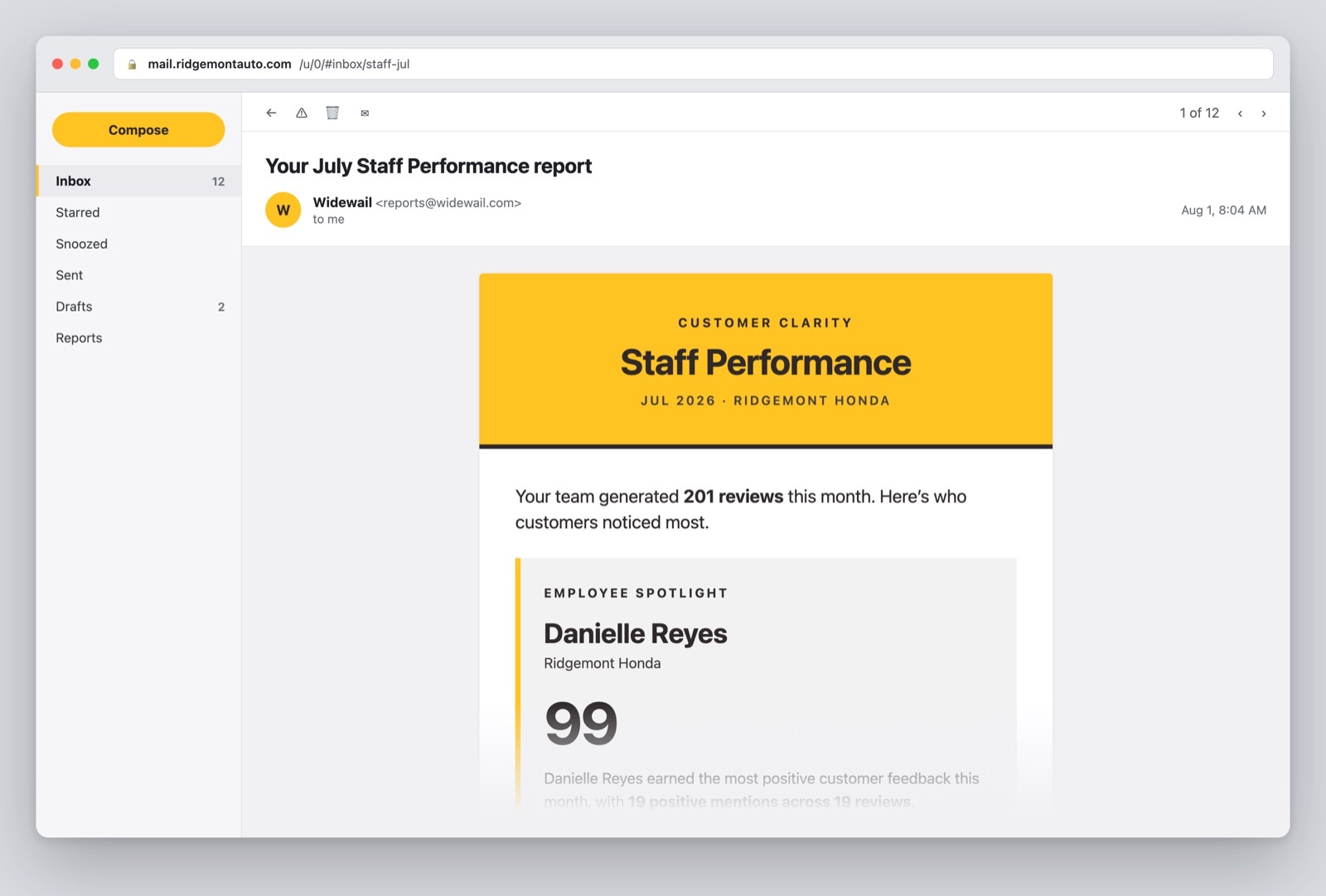
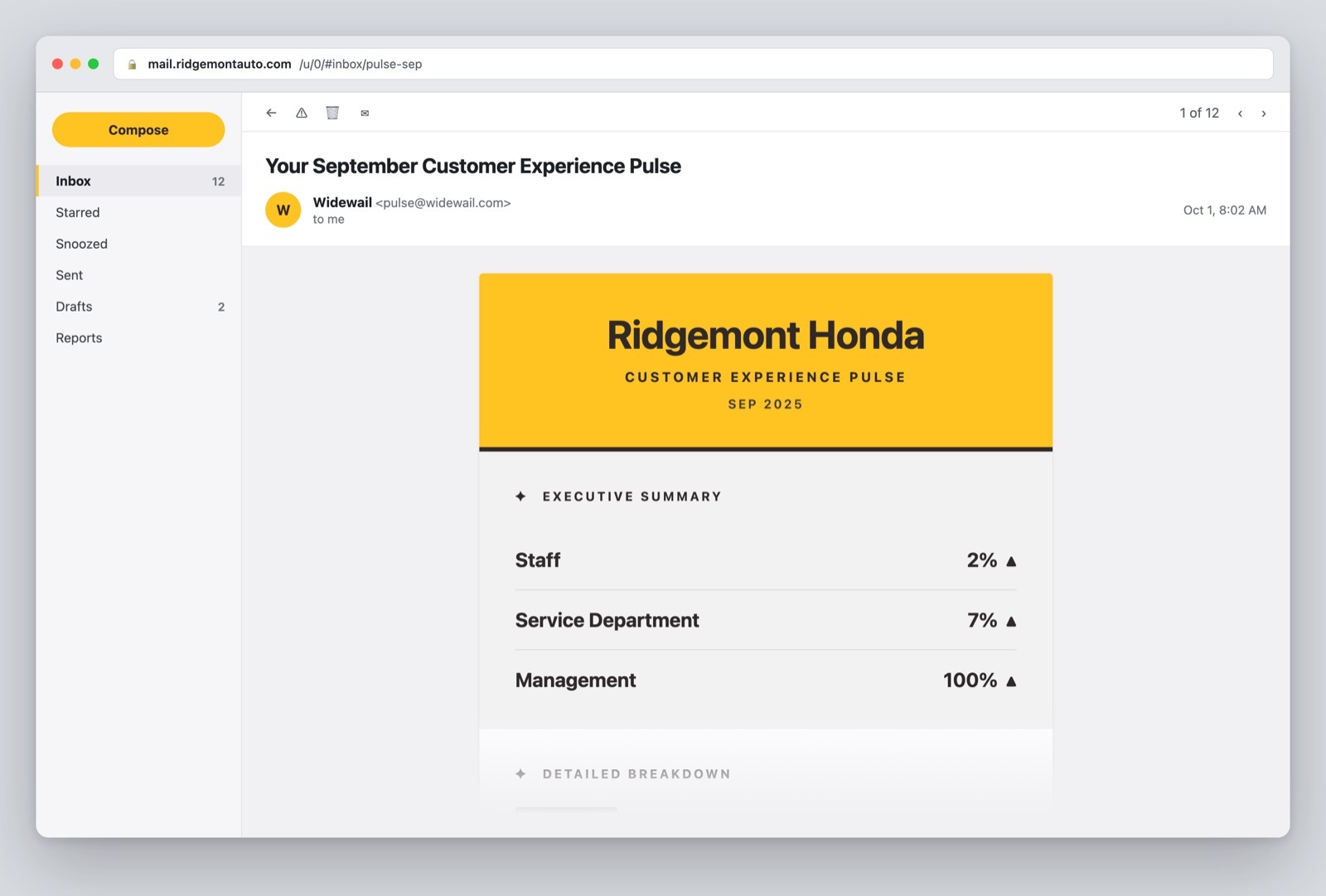
Beta GMs said flatly they will not log in. So the product comes to you: the monthly Staff Performance report with the top and bottom three plus each Employee Snapshot, and the Customer Experience Pulse with the trends and a summary. Built to forward, not to log into.
The ranked next move, not a wall of charts. What to fix first, who to talk to, and which competitor shift is worth reading. Then the same measure next month, so you can see whether the conversation worked.
Every comparison on this page runs on the Widewail Index: public review data for the whole franchise market, refreshed continuously and scored the same way for every store in it.
Both numbers come from the same study, and the gap between them is the argument for coaching to something specific.
All positive staff mentions. Stores in the top 25% took in about 15% more per customer-pay repair order than typical stores.
Communication specifically. Among high performers, the gap is about 30% more per customer-pay repair order.
Customer Clarity is how you move the rest of the team toward that second group. Every person customers named, what they said, and the one conversation worth having this month, so the experience is consistent and highly rated no matter which advisor a customer happens to get.
Read this as a pattern, not a promise. We matched DMS repair-order data to customer reviews at 362 franchise dealerships over six months, customer-pay repair orders only, on a typical ticket of about $580. Stores whose reviews describe staff this way took in more per visit than stores whose reviews did not. That is a correlation, not proof that staff behavior caused it, and it is not a forecast for your store. It covers what a customer spends once they are in the door, in service, not whole-store revenue and not how many customers came in.
Source: Widewail Staff Performance Study, 2026. 362 franchise dealerships, 6 months, customer-pay repair orders only. Correlation, not causation.
Customer Clarity pointed at your own rooftops, using review data we already have. Nothing to install, nothing to configure.
