


Carvana bought seven physical dealerships. Review data shows sales are thriving, but service lane complaints and post-sale communication have collapsed.
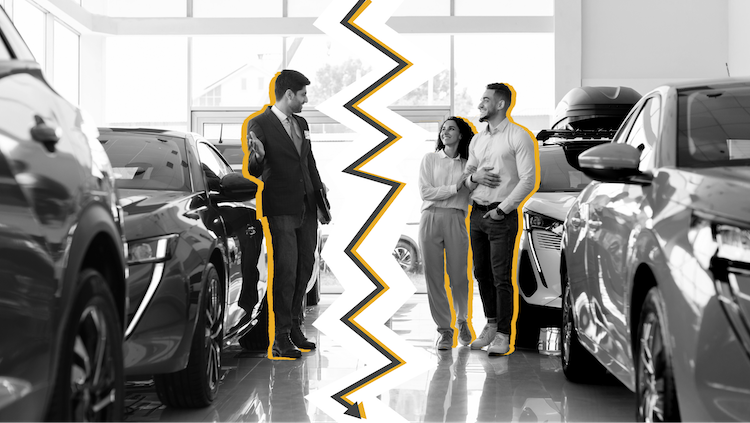
Carvana built an empire on a very specific premise: buying a car shouldn't require talking to a salesperson. By minimizing human touchpoints, prioritizing digital interfaces, and automating the transaction, they built the most frictionless car-buying experience in the industry.
The digital model is working at scale. Company-wide, Carvana sold 187,393 vehicles in Q1 of 2026, a 40% increase from the beginning of 2025.
But recently, the digital-first giant made a surprising pivot. Between February 2025 and today, Carvana has acquired seven franchised CDJR (Chrysler, Dodge, Jeep, Ram) dealerships across six states.
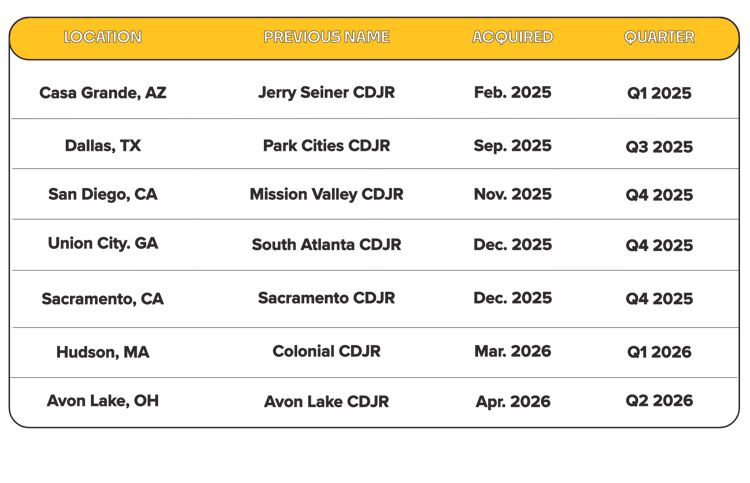
It marks their first real foray into traditional, in-person retail. Which raises a massive operational question: What happens when a low-friction, transaction-first operator takes over a physical showroom and a service drive?
To find out, we focused our analysis on the newly acquired stores where we could directly compare full-year 2025 Voice of the Customer performance against Q1 2026.
The story the data tells is completely polarized, but incredibly consistent. It cuts right down the middle of the dealership.
If you split a traditional dealership into two distinct functions—the transaction and the human relationship—Carvana's historical strengths and weaknesses map perfectly onto them.
When it comes to the showroom floor, Carvana’s streamlined purchasing model is translating beautifully to the physical environment.
At Carvana CDJR of Atlanta, positive mentions of the sales department jumped from 38.8% to 66.7% post-acquisition. At Carvana CDJR of Sacramento—which was the lowest-rated store in our dataset before the buyout—negative sales mentions dropped by more than half, falling from 44.9% to 22.2%.
The data proves that Carvana can sell cars in person just as efficiently as they do online. The transaction can be systematized, digitized, and smoothed out. That part works.
The service side is a completely different story.
Unlike a vehicle purchase, which has a definitive endpoint, the service drive is an ongoing relationship. It requires diagnosing ambiguous problems, managing expectations, navigating parts delays, and keeping customers updated.
When communication breaks down and traditional service operations are disrupted, the customer feedback is immediate and loud.
At Carvana CDJR of San Diego, the overall rating dropped from 4.10 to 2.64 stars following the acquisition, and the negative review share more than doubled to 63.6%. Within those negative reviews, service department complaints accounted for a staggering 71.4% of the feedback, with wait times making up 42.9%.
But Sacramento puts the divide most plainly. At the exact same location, during the exact same period, sales negativity fell from 44.9% to 22.2%, while service negativity surged from 42.0% to 66.7%.
The transaction improved. The service experience did not.
While the split in sentiment is fascinating, the most unambiguous signal in this dataset actually isn't star ratings—it’s review response rates.
Across the recently acquired locations, operators have largely stopped responding to customer reviews entirely.
Response Rate Drop-Off (2025 vs. Q1 2026)
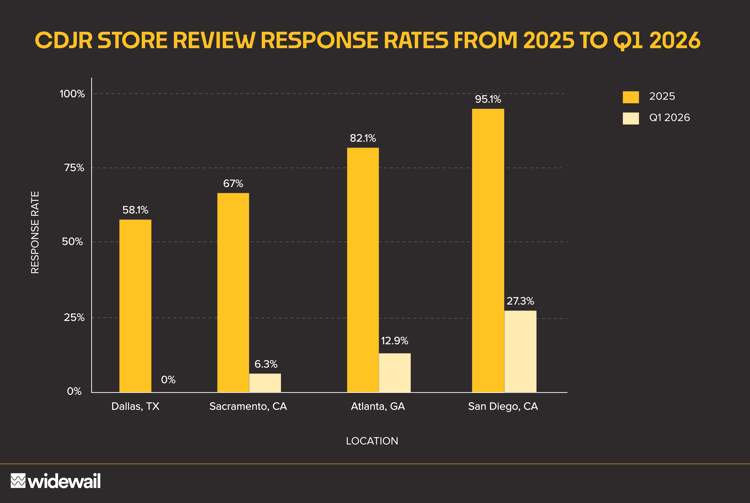
Under prior ownership, these stores were responding to between 58% and 95% of their customer reviews. Under Carvana in Q1 2026, the highest response rate across any location is 27.3%, with one store completely flatlining at zero.
A dealership's review response rate is a direct, measurable proxy for post-sale relationship management. Right now, the data says: once the car is over the curb, the communication stops.
That aligns perfectly with Carvana's core operational model—minimize human touchpoints and automate wherever possible. In a purely digital transaction, that strategy scales beautifully. In a brick-and-mortar environment where customers expect a service advisor to call them back about an engine diagnostic, the lack of communication shows up fast and permanently, in customer feedback.
If you want to see exactly how fast this operational shift happens, Carvana CDJR of Boston is the clearest illustration of the timeline.
Acquired in late March 2026, the Massachusetts store entered the network as the strongest in the dataset—boasting 4.55 stars and a 93.68% response rate. They held that elite standard right through the end of March.
In April, its first full month operating entirely under the Carvana umbrella, the response rate completely evaporated, dropping to exactly 0%.
Not gradually. Immediately.
Carvana has proven to the entire automotive industry that it can systematize the transaction. But the data shows that managing the ongoing human relationship is a different problem entirely.
Carvana’s expansion into brick-and-mortar retail proves that a frictionless, digital-first transaction model is incredibly powerful. But the data also exposes the model’s greatest vulnerability: you cannot automate a relationship.
The service drive is where that reality hits hardest. When the post-sale communication loop breaks down, customer sentiment drops immediately. For traditional dealerships competing against digital giants, this reveals your ultimate differentiator. Your greatest advantage isn’t just your inventory or your physical footprint—it’s your staff's ability to manage the customer long after the car rolls off the lot.
Carvana has proven they can sell the car. But until they figure out how to manage the people, traditional dealers who prioritize communication and proactive response will hold the high ground.

U3GM Blog Post Comments